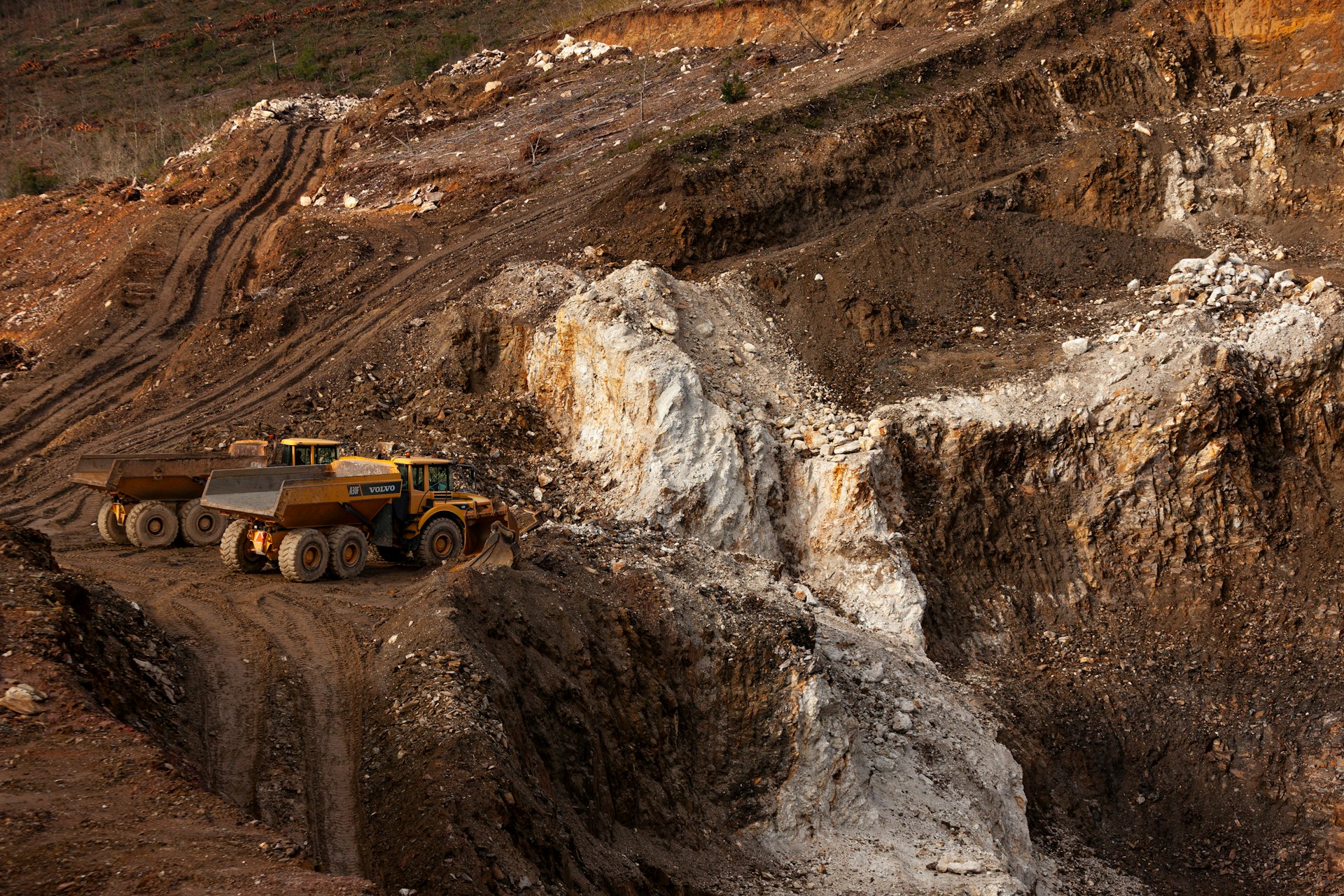
Picture the scene. You’re a mine site mechanic responsible for minimizing downtime on a fleet of mobile assets. A truck limps into the maintenance area and, because you’re clever and competent, you manage to locate the individual part responsible for a loss of power. You know that your colleagues in the purchasing department will happily order whatever replacement components you need, but first you need to identify the unit that you require. If you’re fortunate, you’ll find a part number or a serial number on the item that’s failed. And if you’re not so lucky, the unit will be unmarked. That’s where catalogues come in; mining truck parts catalogues are an invaluable resource when it comes to locating individual components.
Of course, before you start hunting through a catalogue, you’ll want to ensure that you’re looking at the right document. If you’re dealing with OEM systems, then you’ll be referring to publications from manufacturers such as Caterpillar or Komatsu. If, on the other hand, your mine site is using aftermarket assemblies, you’ll be examining catalogues from companies such as DBA Silencing. If you’re interested in the differences between these two options, you may wish to check out our blog post “Exhaust Tubing & Parts: OEM vs Aftermarket“.
In this month’s article, we’ll offer some pro tips for reading mining truck parts catalogues. We’ll also explain why skill in this regard is important, and then offer a step-by-step case study.
Mining Truck Parts Catalogues Helpful Hints
There are a number of things to keep in mind when you’re seeking out a specific component or system in a mining truck parts catalogue.
- Read the front matter. Part numbers can be confusing and a catalogue’s initial pages often provide useful primers on how a particular company’s part numbers are constructed. You may also find handy abbreviation keys in this section.
- Check the footnotes. In some cases, the part numbers for identical components vary. On mining truck models from different years, as one example, or in different regions. Footnotes may also contain information on parts that have been superseded.
- Verify quantities. Depending on the situation, you may wish to order multiple units. We’ll have more to say on this subject in the case study below.
Why It Matters
Mining truck parts catalogues can be a bit bewildering. This is because, while the preparers of these catalogues work hard to ensure that they can be understood by the end user, there is still a great deal of complex information that needs to be included.
Learning how to navigate these publications is an important skill because ordering errors can be costly. If you have the wrong item delivered to your site, you then have the headache of returning it. This can involve repackaging the unit, contacting the customer service department of your supplier, and potentially paying a restocking fee. There may also be significant freight costs to cover.
More importantly, you extend the period during which your mobile asset is unavailable. This is of course the real expense. If you’re interested in this topic, we discuss it in greater depth in our blog post “Minimizing Downtime With Quality Truck Parts“. As the relevant statistics show, unplanned downtime costs for a large mining haul truck can run between $5,000 and $10,000 an hour.
Sample Search
Let’s suppose that you’ve had a hump hose fail. If you’re unfamiliar with hump hoses, you can learn more about this product by taking a peek at our blog post “Hump Hoses Are No Joke“. The hump hoses we carry here at DBA Silencing are made from rubber and, although they’re extremely durable, they can harden over time and eventually develop fissures.
If you have a torn hump hose on your hands, and you’re trying to find a replacement in our catalogue, you’ll want to start with the Table Of Contents.
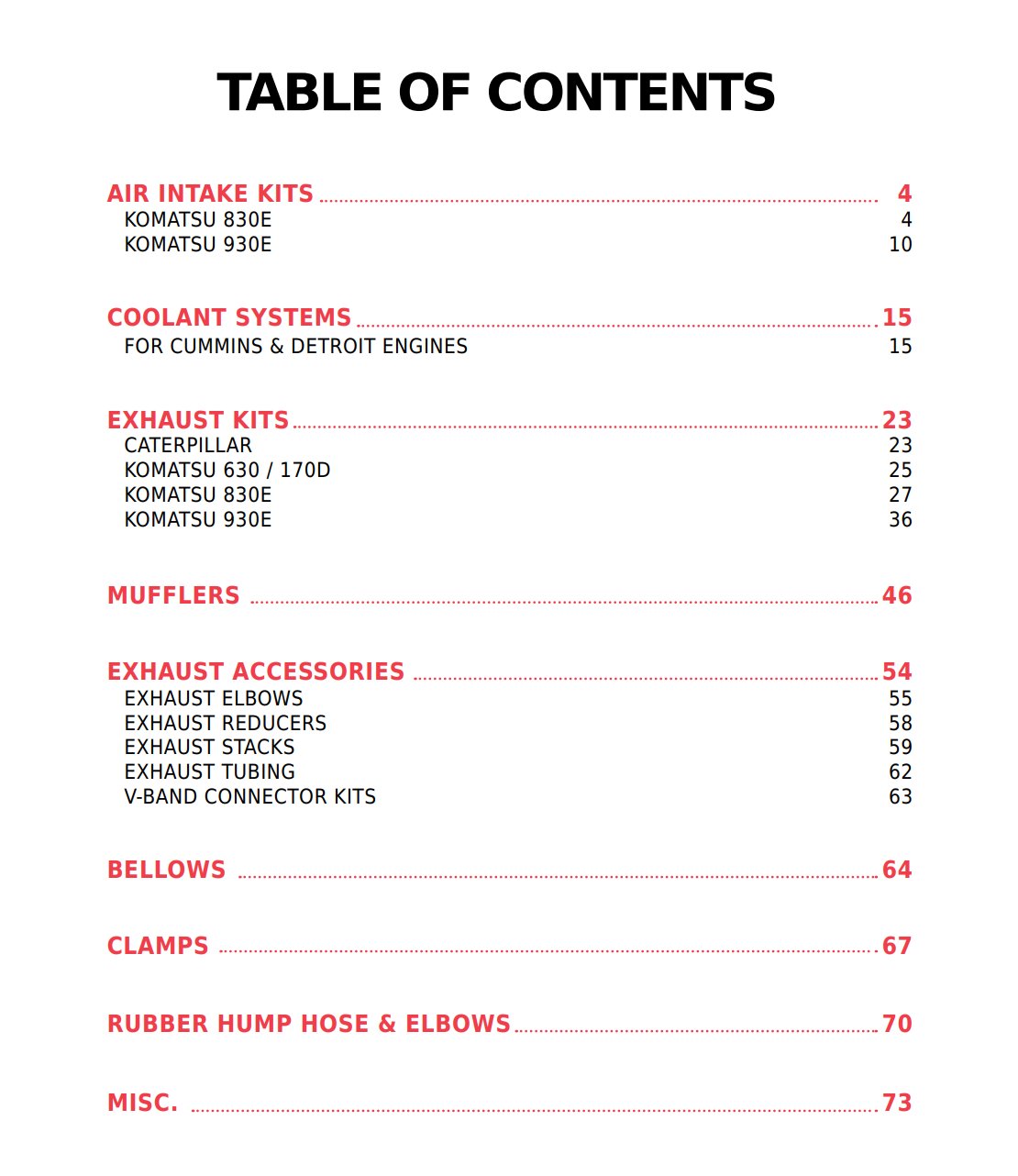
As you can see, we manufacture a variety of components here at DBA Silencing. We are best known for our aftermarket exhaust kits and our mufflers, but we also offer coolant systems and air intake kits. In any case, if you go down the list in our catalogue’s Table Of Contents, you’ll find hump hoses right after bellows and clamps.
If you then go to page 70 of the DBA catalogue, you’ll find our rubber hump hoses and our rubber elbows. Even if you don’t know the part number of the item you need, you may be able to identify it by comparing the dimensions of your damaged component to the dimensions in the catalogue’s charts. Let’s suppose your ripped hump hose is straight rather than bent and is non-reducing. This means that the part you require will be found in this section.
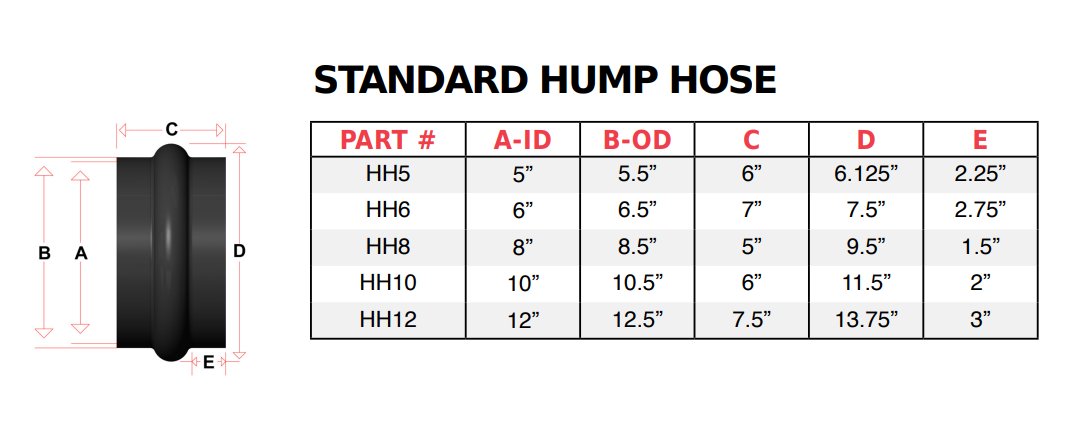
Let’s further imagine that you’re able to determine, through measurement, that the item you want to order is an HH10. Since you already have the DBA catalogue open, you may want to go one step further. You may want to check the air intake system of which your HH10 is a part. If the kit in question is a Komatsu 930-4 Cummins QSK 60 Stage Two system, for instance, then you’ll find the associated diagram on page 13.
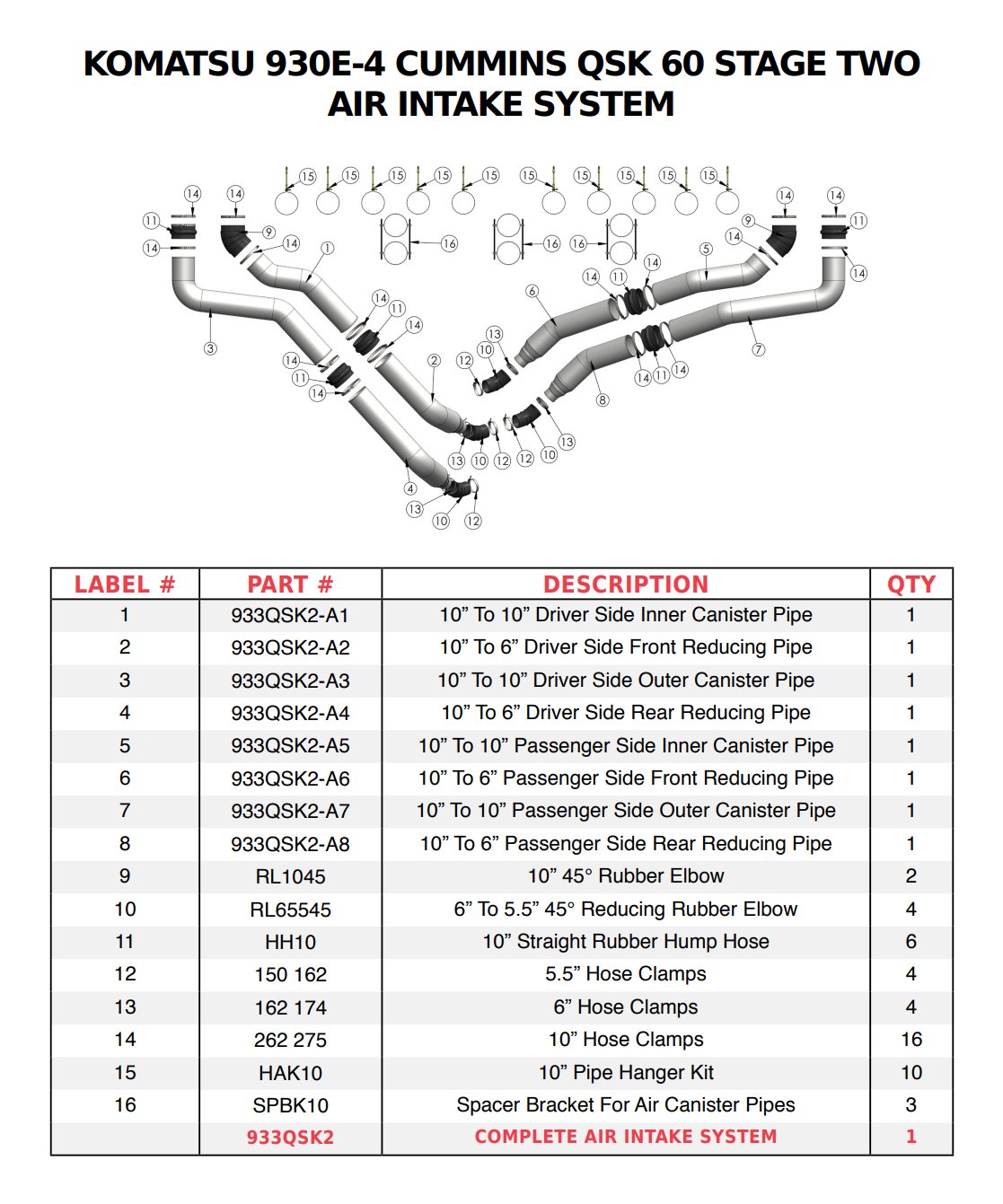
The diagram and the accompanying chart show that the air intake system on your mining truck uses six HH10s. You may wish to order enough units to replace all of them. If one HH10 has failed, after all, the others may be near their limits. And, although you may end up swapping out hump hoses that are still perfectly functional, taking chances in this regard is a false economy. This is because hump hose deficiencies can lead to grit in your system, and even a small amount of grit can dust — or compromise — your million-dollar mining truck engine.
Conclusion
Having outlined some techniques for approaching a mining truck parts catalogue, we’d like to offer one final piece of advice: give us the opportunity to assist you! You can reach us, toll-free, at 1-800-661-5886 or shoot us an email at [email protected]. As mentioned, mining truck parts catalogues can be perplexing. DBA Silencing has been in operation for many decades and so we have the experience necessary to steer you in the right direction; we’ll make sure that you’re ordering the right components in the correct quantities. Depending on the situation, we may be able to save you some money to boot!